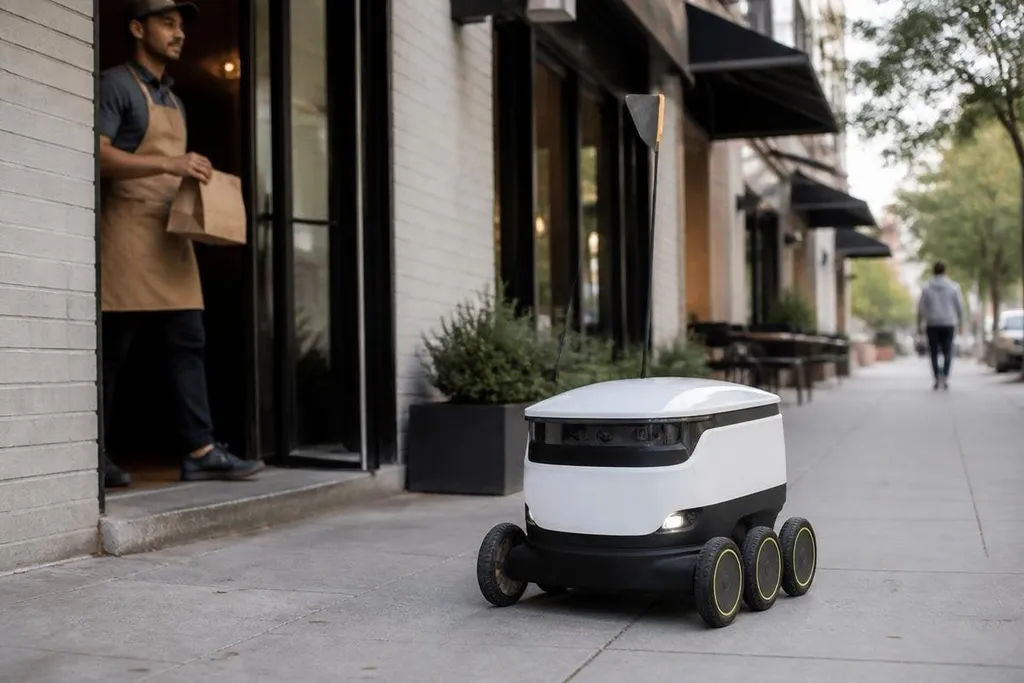
A food delivery robot has a narrow job: carry a meal from a restaurant to a nearby customer without a person walking the full route. That job changes the handoff, the sidewalk, and the work needed behind each order.
- Short trips: The robot suits local routes with a clear start and end.
- Remote help: A human operator can step in when the robot cannot handle a situation.
- Main limit: Curbs, blocked paths, weather, and crowded sidewalks still matter.
The route starts at the restaurant
The process begins when staff load a sealed order into a locked compartment. The robot then leaves the restaurant and follows a mapped route toward the delivery address.
Cameras and other sensors help the robot see people, bikes, vehicles, walls, and changes in the path. LiDAR, which measures distance with light pulses, can help build a view of nearby objects. GPS may help with the broad route, while onboard software handles the short movements around buildings and sidewalks.
That split matters. A map can tell the robot which street to use, but it cannot promise that a parked car, a fallen branch, or a busy group will leave the path clear. The robot has to slow down, stop, or ask for remote help when the scene falls outside its rules.
The handoff is the hard part
A restaurant worker still has to place the correct meal in the correct compartment. The customer then gets an alert and uses a code or app control to open the compartment at the destination.
This removes one walking task from the route, but it adds checks around the box. The food must stay upright, the compartment must remain closed, and the robot must reach a place where the customer can safely stand without blocking other people.
That last step is easy to miss. A robot that reaches the address but stops beside a curb, behind a parked vehicle, or inside a crowded entrance has completed the map route without completing the delivery.
A route that ends at the curb leaves the restaurant or customer to finish the job. Robot 24 reports on the machines and companies behind food delivery automation, with the delivery task, not the map route, as the useful test.
What changes for restaurants and customers
Restaurants can use a robot for nearby orders when the route, order size, and local rules fit the machine. The business still needs staff to load meals, handle customer questions, and deal with orders that fall outside the robot's route.
Customers get a different kind of handoff. They may collect the meal from a compartment rather than from a courier at the door, which can work well at a fixed location such as a campus building or apartment entrance.
The model works best when the trip is repeatable. A route with wide sidewalks, known drop points, and few crossings gives the robot fewer decisions to make. A route with stairs, narrow paths, heavy traffic, or poor access gives the human courier a clear advantage.
Food temperature also needs a direct answer. A moving compartment is not the same as a heated restaurant pass or an insulated courier bag. The operator has to show how the robot keeps food within a safe serving range during the trip.
Where the limits show up
Sidewalk robots do not remove every cost from food delivery. They replace some walking with loading, route checks, remote supervision, fleet charging, and maintenance.
Access is another limit. A robot may handle a flat pavement route and still fail at a stairway or a door with no safe stopping area. Local rules can also decide where the robot may travel and how it must react around pedestrians.
I’d skip a robot delivery plan until the operator can show its route rules, remote support process, food storage method, and response to blocked paths.
The open question is how much human help each trip needs. If a remote operator must watch every route closely, the robot may reduce walking without reducing much of the labor.
If one operator can safely support several robots, the cost picture changes, but that result needs measured field data rather than a short demonstration.
A practical check before using one
Use these points when judging a food delivery robot for a restaurant, campus, or housing site:
- Map the route: Check crossings, curb cuts, doors, slopes, stairs, and places where people gather.
- Watch the handoff: Confirm that staff can load orders quickly and customers can open the compartment without blocking the path.
- Check food storage: Ask how the compartment handles hot and cold meals during the full trip.
- Test remote support: Find out who takes control when a person, vehicle, branch, or closed path blocks the robot.
- Count the extra work: Include charging, cleaning, repairs, loading, customer support, and route changes.
- Set a pass rule: Decide which delivery time, failure rate, and labor cost would make the service worth keeping.
Food delivery robots make the most sense on short, repeatable routes with clear drop points. The next useful proof is not a staged run across an empty sidewalk; it is a full service record showing how often the robot finishes the route without human help.